FLEX APPEAL: STEFAN YTTERBORN ON THE CHANGING FACE OF ‘70s SKATEBOARD CULTURE
IN CONVERSATION WITH LONGTIME SKATER, ENTREPRENEUR AND BRAND BUILDER ON HOW A CHANCE THRIFT-STORE DISCOVERY SPARKED AN ARCHIVAL OBSESSION, FRAMING THE HISTORY OF SKATEBOARDING THROUGH THE LENS OF FIBREFLEX DESIGN AND INNOVATION.
A chance encounter donating clothes to charity brought an entire era back to life for Stefan Ytterborn. Lying among the donations was a late-1977 blue FibreFlex Freestyle skateboard, rolling on yellow-and-red YO-YO wheels. It was an instant portal to his childhood in Sweden, where as a teenager he had ridden early decks from brands like Newporter and Logan before moving on to vertical styles of Dogtown and Santa Cruz.
Yet, the longing for a Fibreflex had always lingered in the background–it belonged to a shimmering Californian universe he could only connect to through the pages of SkateBoarder magazine. Even then, long before he had the technical language for it, the fiberglass layups and engineered flex patterns registered deeply with him. He could tell that someone was thinking about these objects the way an engineer or a designer would.
Decades later, after becoming a longtime skater, product guy, and brand builder behind pioneering brands like POC and CAKE, Ytterborn brought that thrift-store board home intending merely to clean it up a little. Instead, the impulse sparked an obsession, sending him scrolling through collector groups and eBay deep into the night. What began as a moment of pure nostalgia quickly transformed into something much bigger: a collection.
This unrivaled archive of original 1975-1979 decks became the foundation for his debut book, Flex Appeal: The Changing Face of ‘70s Skateboard Culture. Created alongside photographer Jörgen Brennicke and designer David Gonzalez, the book is a beautifully crafted design homage and a record of compulsion, made for people who already know this world well, and for others who may feel its pull through its pages.
We spoke with Stefan Ytterborn about the nostalgia-fuelled discovery that reignited his passion for skateboarding history, the process of assembling his collection of FibreFlex boards, and the cultural and design legacy captured in Flex Appeal.
 Portrait Picture of the author Stefan Ytterborn: "Photo Tobias Lundkvist", Flex Appeal, gestalten 2026
How did your personal journey with collecting Fibreflex boards begin? Do you remember the very first board you acquired, what was it about that specific deck that first caught your eye, do you still have it, and is it in the book?
“It started way back in the 70s being a 12 year old, aspiring for the real stuff. The gear used by the superstars highlighted in SkateBoarder Magazine. At the time, saving every cent to upgrade to the next level of boards, not ever reaching the dream of the Fibreflex.
Then, at a charity station handing in excessive stuff, a Fibreflex lay there in front of me and I just had to take it home. Not that I had a plan of collecting or anything. I got goosebumps and just had to bring it home”.
What inspired you to open up your impressive archive of 1975–1979 boards to bring Flex Appeal to life right now?
“I started refurbishing and collecting the decks without a clear plan. Then, as I was given a never used super rare Fibreflex Greg Taie slalom board from my colleagues, the ambition stepped up and I decided to collect their full range from their 1974/75 launch, through 1979 and all originals. And when I completed it, I was like, what´s next and I decided to make a book”.
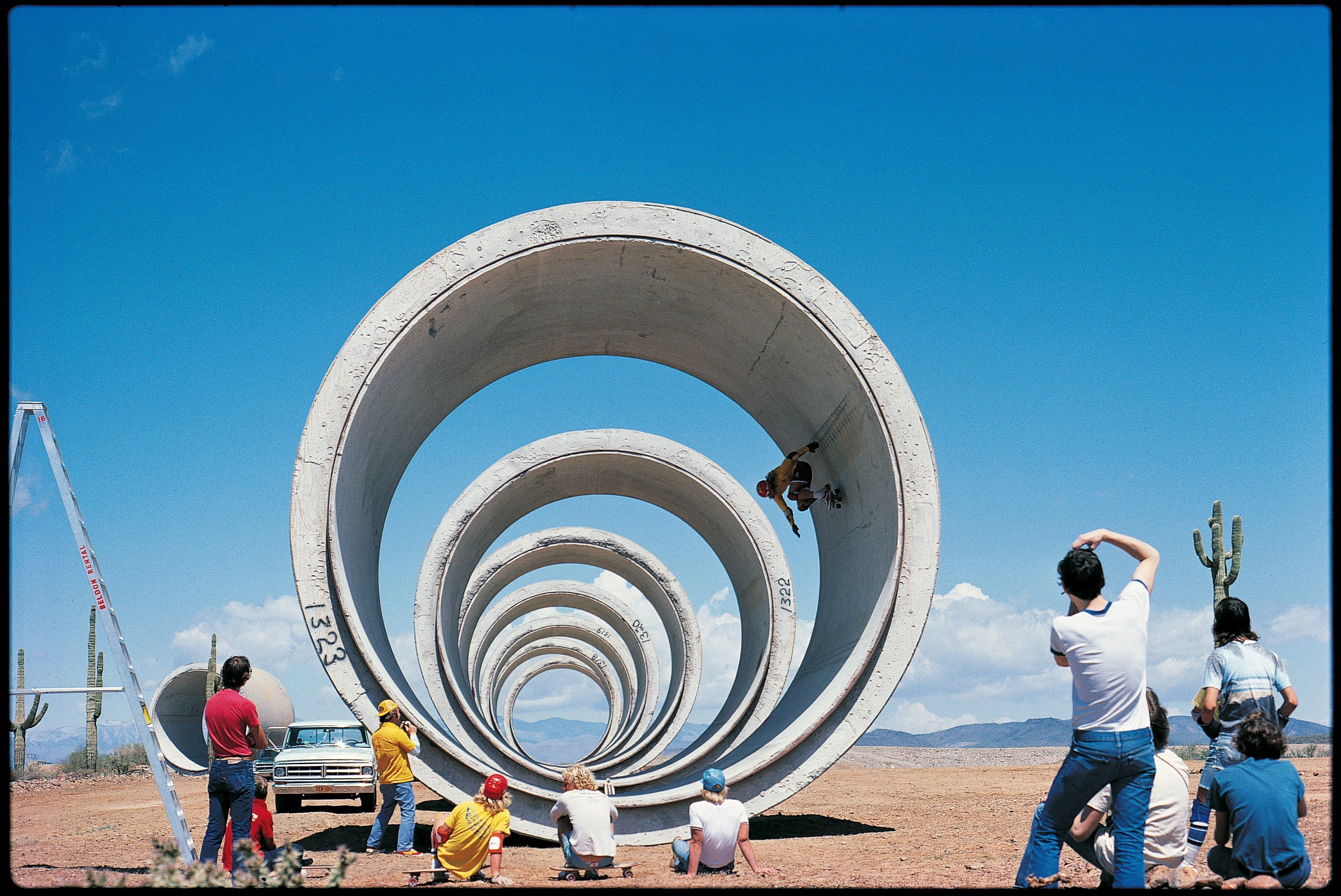
 Photo Warren Bolster, Courtesy of Concrete Wave Editions, Flex Appeal, gestalten 2026
The Industrial Design Innovation of FibreFlex Skateboards
In the book, Fibreflex comes across as the defining brand of the late '70s. How did their unique designs and quick innovations change the skateboarding world at that time?
“The evolution of skate boards from the mid 70s and until the end was super fast and Fibreflex, with their deck lamination tech, using maple cores with archery fibreglass top and bottom, put them ahead initially, but the pace of development quickly made them one among the top brands and not the evident leader.
The collection and the book is actually more of a mirror reflecting on how an industry together with avid athletes breaking new barriers on a weekly basis, changed, potentially faster than any performance oriented, sport associated ever throughout history. Not only when it comes to gear and product development but just as much culturally, still with its roots in surfing”.
When you look at these '70s boards, what design lessons do you see that are still relevant for product designers, like yourself today?
“Everything. They are the true evidence of how a competitive landscape and market demand drives innovation”.
How California Skate Culture Shifted from Sport to Street Rebellion
Skate culture in the late ‘70s has always had a rebellious, raw undercurrent, an energy that feels very familiar to our neighbourhood here in Kreuzberg. How does Flex Appeal capture that energy?
"Well, this is a part of the changing culture. Skateboarding went from being sporty, even preppy, towards raw, radical, independent and surf punk, and that only in 5 years. Skateboarder athletes skills and demand for accurate products were a part of that unique passage in time".
Pre-order your copy of Flex Appeal. Explore the complete design evolution and cultural heritage of 1970s skateboarding. Pre-order your copy here.

Photo Warren Bolster, Courtesy of Concrete Wave Editions, Flex Appeal, gestalten 2026
What was the collaborative process like working with photographer Jörgen Brennicke and creative director David Gonzalez to capture the aesthetic of the era for this book?
“Sharing interest and in depth collaborations with POC and CAKE, we pretty much share views”.
If you had to highlight three boards from the book as the ultimate representation of that '70s golden era, which ones would you pick and what makes them stand out?
“The cover board, a Henry Hester signature deck from 1976 with NOS golden Gull Wings and 1st Gen. Kryptonics. It's a gem. Henry Hester was always my big idol and even though he was on Tracker trucks and Road Rider wheels, this is a combo that is different, at the same time perfectly in line with how I would have had it, if I had had the chance back then".
 Photo Joergen Brennicke, Flex Appeal, gestalten 2026
The second one is the Greg Taie signature board, I got from colleagues, which is aesthetically perfect and extremely rare.
 Photo Joergen Brennicke, Flex Appeal, gestalten 2026
The third one is actually one of the boards from competing brands and that's the Z-Wood Shogo Kubo signature model with Gull Wings 7s and Powerflex wheels. Everything was in perfect condition and Shogo Kubo was by far the most stylish rider at the time. His lay backs were to die for”.
 Z-Wood Shogo Kubo, Flex Appeal, gestalten 2026
Get your copy of Flex Appeal now.